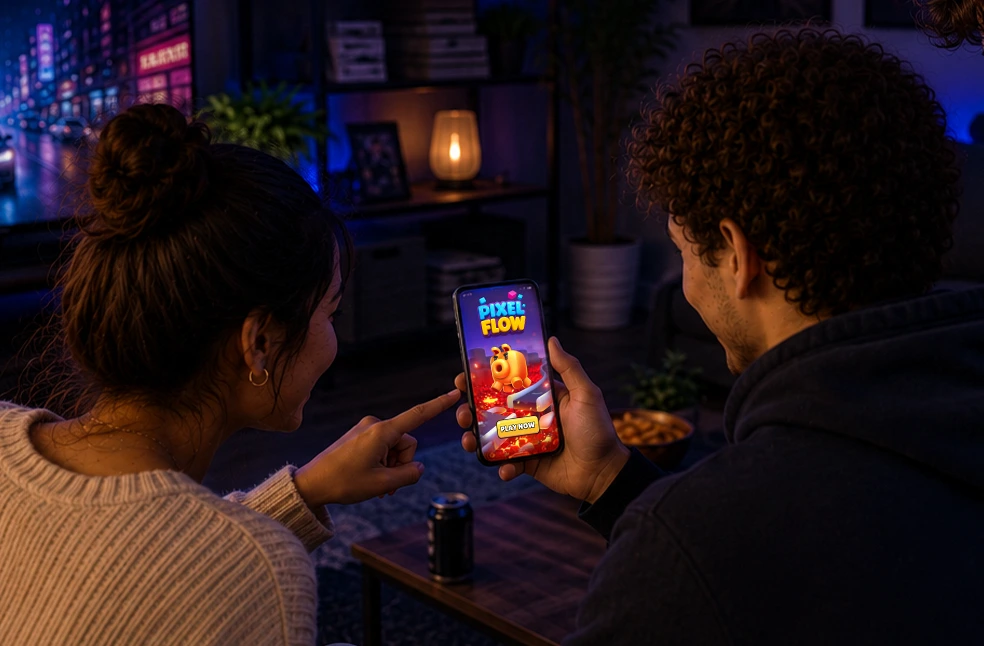






Pixel Flow Scaled Installs 7\u00d7 While Acquiring High-LTV Users Powered by InMobi
Global
Share

Pixel Flow Scaled Installs 7× While Acquiring High-LTV Users Powered by InMobi

Solution

Acquiring new users, In-App monetization
10 Mn
10 million players globally within months of launch
20
Only casual title in the past year to break into the US top 20 highest-grossing mobile games
$1bn
Scopely acquired a majority stake in Loom Games at a valuation exceeding $1 billion - Feb 2026
"From the very beginning of our UA strategy, we have prioritized user quality just as much as scale. During our initial testing with InMobi, our brief was simple: find users who stay and spend. The early test results were very encouraging, and as we increased spend, we were able to maintain performance while scaling. Throughout the process, the InMobi team was highly engaged, proactive, and genuinely committed to helping us achieve our goals."
Atalay Atar
Lead Marketing Manager, Loom Games

About Pixel Flow

Loom Games launched Pixel Flow – a casual puzzle game with a novel sorting-shooter mechanic - and scaled it to a top 20 grossing US title without a publisher or a marketing war chest.

Why user quality is everything:

  • Pixel Flow earns through two paths - in-app purchases and advertising
  • Every player acquired generates revenue on both tracks
  • A player who stays, engages, and returns compounds value on both dimensions over time
  • Low-quality installs inflate volume and erode the model

Loom Games works with InMobi across both sides - user acquisition to grow the player base, and monetization to maximize revenue from the users acquired. Better users drive higher ad yield, stronger returns fund more UA, and the cycle sustains.


About Pixel Flow Tile Image

The Challenge

Organic momentum got Pixel Flow onto the chart fast. Loom Games saw the opportunity clearly: in mobile gaming, the studios that layer in paid UA while organic is still running build a compounding growth engine. They acted on it. Every partner they evaluated had to clear the same bar:

  • Can you find users who actually stay and spend - not just install? 
  • Can you hit our ROAS targets from week one, without a learning grace period?
  • If the first cohort proves quality, can you scale without diluting it?
The Challenge Tile Image

How The Partnership Grew

InMobi’s performance ad experience, Action | Acquire entered the Loom Games UA portfolio as one channel among several. The brief was tight: prove performance on iOS in the US market. The first cohort either delivered or it didn’t.

The Test

InMobi came in with existing depth - 60,000+ SDK-integrated mobile apps, behavioral data across the global gaming ecosystem. Combined with Pixel Flow's own 1P data - player purchase history, session behavior, and engagement patterns - lookalike audiences modelled on their highest-value players were ready before the first impression was served.

The Signal

Early cohort data held. ROAS targets were met and held consistently across the first month. Users were retaining at Day 30 at a rate 33% above the category benchmark - staying, spending, and generating ad revenue. The exact player profile Pixel Flow’s monetization model depends on.

The Scale Decision

When the D30 numbers came in, Loom Games increased the InMobi DSP allocation. Then increased it again. Spend scaled multi-fold over 3 months - every incremental dollar returning the same high LTV users. Install volume grew 7×. User quality held throughout. InMobi moved from one channel in the portfolio to a core, scaled partner.

How InMobi Delivered it

The quality outcomes didn’t happen by chance. Action | Acquire ran 3 capabilities in parallel from the first day of spend - and the way they fed each other over time is what separated this from a standard UA engagement.
How InMobi Delivered it Tile Image
Audience: Starting With the Right Signal

Most UA campaigns spend their first weeks in a learning phase - bidding broadly, accumulating data, slowly narrowing toward the right audience. Pixel Flow couldn’t afford that ramp.

InMobi came in with existing depth - 60,000+ SDK-integrated apps, behavioral data across the global gaming ecosystem. Lookalike audiences modelled on Pixel Flow's highest-value players were ready before the first impression was served.

  1. Players who had demonstrated in-app purchase behavior in similar game categories
  2. Strong session depth signals consistent with high-retention profiles
  3. Return visit patterns aligned with Pixel Flow’s retention model
Bidding Strategy Built Around LTV

The bidding structure was designed from day 1 to optimize for post-install user value - every dollar pointed at players most likely to stay and spend.

  • CPI bidder: drove efficient install volume across the funnel
  • ROAS bidder: continuously optimized toward downstream purchase events, session depth & return visits
  • Predictive LTV scoring: ran across both bidders, weighting budget toward players with strong purchase propensity and long-term retention signals

Audience segments with weak post-install metrics were deprioritized in real time. Budget kept concentrating toward user profiles that held up at Day 7, Day 14, and Day 30.

Creative That Followed the Audience

InMobi ran structured creative testing across formats and placements, optimizing toward the combinations that drove the strongest post-install engagement.

  • Continuous A/B testing kept every pairing sharp as the audience evolved
  • Heat-map analysis identified which formats drove post-install depth
  • The creative layer grew more precise week over week - without manual intervention from the Pixel Flow team
The Feedback Loop: How It Compounded Over 3 Months

The 3 capabilities fed each other continuously. Audience data sharpened the inputs going into the bidding layer. Bidding signals - which segments were actually converting downstream - fed back into audience refinement and creative allocation. Creative performance data updated segment prioritization.

Each optimization cycle made the next one more precise. Over three months, this compounding effect translated directly into cohort quality: stronger retention, higher revenue per user, and a D30 benchmark 33% above category average.

Impact

3 months of consistent ROAS delivery and high-LTV user acquisition produced results across metrics that matters to a hybrid-casual advertiser. Install volume grew 7×. The users acquired retained at Day 30 at a rate 33% above category benchmark - the clearest signal the campaign was finding players with high LTV. Pixel Flow held its chart position. The flywheel ran.

7x
Install Volume Growth*
3%
IHigher D30 Retention vs Category* 
*All figures are relative - indexed to baseline or category benchmark. No absolute volume or rate figures are disclosed.

Relevant Case Studies

Contact Us